Metadata Services: 7 Key Capabilities and 6 Notable Solutions
This is part of a series of articles about metadata management.
What are Metadata Services?
A metadata service provides structured information (metadata) about resources, such as cloud instances, data assets, or security authenticators. It allows systems to discover, manage, and interact with data about their environment, acting as a centralized repository for configurations, attributes, and data lineage.
These services integrate with various data sources, applications, and storage systems, aggregating metadata from disparate environments. This allows organizations to maintain a consistent view of their data landscape, improve data quality, and streamline data management processes.
There are two main types of metadata services:
- Data catalog/management services (e.g., OpenMetadata, Apache Atlas): Centralizes metadata for tables, databases, and pipelines for discovery and governance.
- Cloud instance metadata (e.g., AWS IMDS, Akamai/Linode): Provides instance-specific data (IP addresses, security groups) to running virtual machines via a local API, enabling automated configuration and security.
In this article:
- Data Catalog vs. Cloud Instance Metadata Services
- Why Metadata Services Matter
- Key Features of Metadata Services
- Primary Use Cases of Metadata Services
- Notable Metadata Services
Data Catalog vs. Cloud Instance Metadata Services
Data catalog and cloud instance metadata services both deal with metadata, but they serve different layers of the stack and solve different problems.
Data catalog services operate at the data layer. They collect metadata about datasets, schemas, pipelines, and usage. Their goal is discovery, governance, and lineage tracking. Users query them to find tables, understand ownership, trace data flow, and enforce policies. These systems integrate with databases, data warehouses, and ETL tools, and they persist metadata centrally for organization-wide use.
Cloud instance metadata services operate at the infrastructure layer. They expose runtime metadata about compute resources such as virtual machines or containers. This includes instance IDs, network configuration, IAM roles, and region details. The metadata is accessed locally (often via a link-local IP like 169.254.169.254) and is primarily used by the running workload for bootstrapping, configuration, and authentication.
The scope and access patterns differ significantly. Data catalogs are shared, persistent systems accessed by humans and services across the organization. Cloud instance metadata services are ephemeral, instance-scoped, and accessed only from within the running environment.
Why Metadata Services Matter
Trust and Findability Across the Data Estate
Metadata services make data discoverable by indexing datasets, schemas, owners, and usage signals. Search and tagging allow users to locate relevant data without knowing where it lives. Rich context (descriptions, sample queries, freshness indicators) reduces guesswork and prevents misuse.
They also improve trust. Lineage shows how data was produced and transformed. Quality signals such as tests, anomalies, and SLAs help users judge fitness for use. With clear ownership and documentation, teams can rely on shared data instead of creating duplicates.
Governance and Compliance at Scale
Metadata services encode policies as metadata, including classifications (PII, PHI), retention rules, and access controls, and apply them consistently across systems. Automated scans and lineage help identify where sensitive data exists and how it flows.
They support audits by providing a record of access, changes, and data movement. Policy enforcement can be integrated with query engines and storage layers to mask, filter, or block data as needed. This reduces manual effort and lowers the risk of non-compliance.
Self-Service Analytics and Democratization
By centralizing metadata, these services let analysts and engineers find and use data without relying on gatekeepers. Curated datasets, certified tables, and reusable metrics lower the barrier to entry.
Integration with BI tools and notebooks allows users to explore data with context in place. This shortens time to insight and reduces back-and-forth with data teams. Standardized definitions also align metrics across departments.
AI Readiness Provides Context for Agents and LLMs
AI systems need structured context to operate safely and accurately. Metadata services provide schemas, semantics, and lineage that help models understand what data means and how it can be used.
They enable retrieval-augmented generation over trusted data assets, improve prompt grounding, and enforce access policies for AI workloads. With clear data contracts and quality signals, agents can select the right sources and avoid hallucinating or using stale data.
Key Features of Metadata Services
1. Data Cataloging
Data cataloging is a core feature of metadata services, providing a searchable inventory of data assets across an organization. A data catalog automatically collects metadata from databases, data warehouses, files, and APIs, compiling details like schema, data types, owners, and usage statistics. This enables users to discover available datasets and assess their suitability for different use cases.
A data catalog supports data stewardship and collaboration by allowing stakeholders to annotate datasets, assign business context, and track data ownership. It also highlights missing, incomplete, or outdated metadata. As organizations scale, automation and self-service capabilities become increasingly valuable for data management and discovery.
2. Data Lineage Tracking
Data lineage tracking visualizes the flow of data through systems, documenting its origin, transformations, and destinations. This feature helps teams understand how data is generated, processed, and consumed. By mapping data pipelines and dependencies, lineage tracking helps identify bottlenecks, errors, and compliance risks.
With accurate lineage information, teams can troubleshoot issues, validate analytics integrity, and support impact analysis for proposed changes. Data lineage also supports regulatory compliance by providing audit trails that show how sensitive information moves and changes. Automated lineage tracking keeps this visibility up to date in dynamic environments.
3. Metadata Integration
Metadata integration is the ability of metadata services to aggregate and synchronize metadata from multiple sources, systems, and formats. Modern data ecosystems often include cloud platforms, on-premises databases, and SaaS tools. Metadata integration unifies metadata from these environments, providing a holistic view of the data landscape.
Effective metadata integration reduces silos and enables consistent metadata management across tools and teams. It also supports interoperability by feeding metadata into downstream applications such as data quality tools, governance platforms, and analytics solutions.
4. Governance and Policy Management
Governance and policy management features enable organizations to define, enforce, and monitor rules for data usage, access, and quality. Metadata services centralize the creation and application of data policies, such as data classification, retention, masking, and access controls.
Automated policy enforcement reduces manual errors and helps organizations adapt to changing regulations. Audit logs and reporting provide visibility into policy adherence and help identify violations or risks. Governance tools within metadata services support collaboration among data stewards, compliance officers, and business users.
5. Business Glossary Management
Business glossary management provides a structured way to define and maintain business terms, metrics, and data definitions across an organization. By linking business concepts to technical metadata, a business glossary connects technical teams and business stakeholders. This promotes consistent terminology and clearer communication about data assets.
A maintained business glossary supports data literacy and data governance practices. It enables users to trace how business terms relate to specific datasets, reports, and processes. Integration with features such as data catalogs and lineage improves clarity and usability of organizational data.
6. AI-Powered Enrichment and Search
AI-powered enrichment augments raw metadata with inferred context. Models can classify datasets (e.g., PII detection), generate descriptions, suggest tags, and map columns to business terms. This reduces manual curation and fills gaps in poorly documented systems. Enrichment pipelines often run continuously, updating metadata as schemas and usage change.
Search is improved through semantic understanding rather than keyword matching. Users can query in natural language (“revenue by region last quarter”) and retrieve relevant datasets, dashboards, and queries. Ranking incorporates usage signals, lineage proximity, and quality indicators. This leads to faster discovery and fewer false positives compared to basic text search.
Some platforms also use embeddings to link related assets across systems. For example, a table can be connected to dashboards, notebooks, and upstream pipelines based on semantic similarity and lineage. This creates a graph of context that users can navigate without knowing exact names or locations.
7. Agent Integration via APIs and MCP
Metadata services expose APIs that allow external systems and agents to read and write metadata. Common operations include searching the catalog, fetching schema details, retrieving lineage, and updating annotations. This enables integration with data pipelines, BI tools, CI/CD workflows, and governance engines.
Model Context Protocol (MCP) and similar interfaces standardize how AI agents access metadata. Instead of hardcoding connectors, agents query a metadata service as a source of truth for schemas, permissions, and data meaning. This allows agents to select datasets, generate queries, and validate outputs with proper context.
Tight integration with agents also supports policy enforcement. Before an agent accesses data, it can check classifications, access rules, and masking requirements via the metadata service. This ensures AI workflows follow the same governance controls as human users. Over time, feedback from agent usage can be written back as metadata, improving ranking, quality signals, and documentation.
Related content: Read our guide to metadata solutions (coming soon)
Primary Use Cases of Metadata Services
Data Warehousing and Data Lakes
In data warehousing and data lake environments, metadata services organize, track, and manage large volumes of structured and unstructured data. Metadata catalogs document schema, partitioning, and storage details of data assets, helping users find and understand datasets stored across platforms.
Metadata services also support data ingestion, transformation, and quality monitoring. By integrating with ETL tools and data pipelines, they help keep metadata aligned with evolving data assets. This visibility supports compliance, cost management, and analytics initiatives.
AI and Machine Learning
AI and machine learning workflows depend on metadata for data discovery, feature tracking, and model management. Metadata services help data scientists locate training datasets, understand their provenance, and assess data quality before building models. Lineage tracking ensures that models are trained on current data.
Metadata services also document the lifecycle of machine learning models, including versioning, hyperparameters, and deployment environments. This supports reproducibility, auditing, and AI governance requirements. Automated metadata capture supports collaboration between data engineering and data science teams.
AI Agents and Automated Workflows
Metadata services provide the context that agents need to operate on data safely and effectively. Agents can query the catalog to discover datasets, retrieve schemas, and understand relationships before generating queries or triggering pipelines. This reduces guesswork and prevents invalid operations against unknown structures.
They also enable dynamic decision-making in workflows. For example, an orchestration system can use metadata to select the latest partition, route jobs based on data classifications, or skip steps when quality checks fail. Lineage and dependency metadata allow agents to resolve upstream requirements and avoid breaking downstream systems.
Feedback loops improve over time. Agents can write back metadata such as query patterns, data quality signals, and usage frequency. This continuously refines search ranking, recommendations, and automation rules. With governance metadata integrated, agents can enforce access controls and masking policies during execution.
Business Intelligence and Analytics
Business intelligence and analytics platforms rely on metadata services to provide context and consistency in reporting and dashboards. Metadata catalogs and business glossaries help analysts identify data sources and understand definitions aligned with business metrics.
Metadata services also support impact analysis, change management, and auditing within analytics environments. By tracking how data is transformed and consumed in reports, organizations can assess the impact of upstream changes and maintain accuracy in business insights. Integration with governance features helps ensure compliance with policies and regulations.
Compliance and Auditing
Metadata services act as a system of record for data governance activities. They track who accessed data, what changes were made, and how data moved across systems. This creates an audit trail that supports internal reviews and external regulatory requirements.
Classification metadata (e.g., PII, financial data) combined with lineage helps identify where sensitive data resides and how it propagates. This is critical for regulations that require data minimization, retention controls, and breach impact analysis. Automated scans and policies reduce reliance on manual tracking.
During audits, teams can quickly answer questions about data origin, transformations, and usage. Reports can be generated from metadata to show compliance with policies such as retention, masking, and access restrictions. This lowers the operational burden of audits and reduces the risk of gaps or inconsistencies.
Notable Metadata Services
Data Catalog and Metadata Management Services
1. OpenMetadata
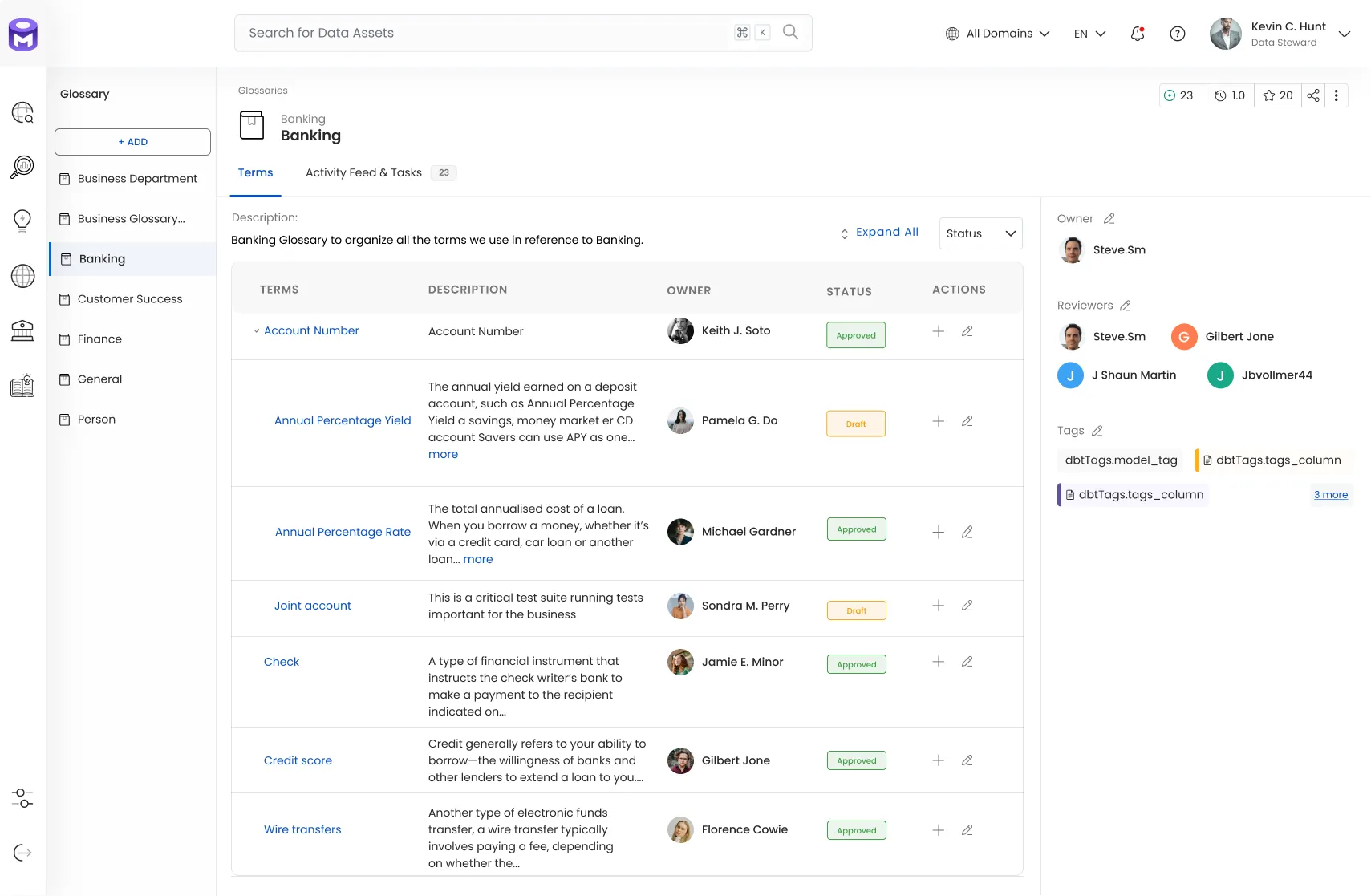
OpenMetadata is an open-source metadata platform and AI context layer that organizes technical and business metadata into a single, queryable knowledge graph. It provides end-to-end metadata management across catalog, lineage, quality, governance, and AI context.
Key features include:
- Open metadata standard: OpenMetadata defines an open schema for tables, dashboards, ML models, lineage, and ownership, with W3C support including MCP, RDF, DCAT, DPROD, ODCS, and OpenLineage.
- Native connectors at scale: 130+ connectors for databases, warehouses, BI tools, pipelines, and ML systems ingest metadata automatically without custom integration work.
- Built-in data quality and observability: Test suites, profilers, and incident workflows run alongside catalog functions, so observability is part of the platform rather than a separate tool.
- Column-level lineage and impact analysis: Lineage is captured from SQL queries, ETL jobs, and orchestrators with column-level granularity to support downstream impact tracking.
- Apache 2.0 licensed and community-driven: Open source under Apache 2.0, with an active community contributing connectors, schemas, and integrations.
Source: Open MetaData
2. Collate

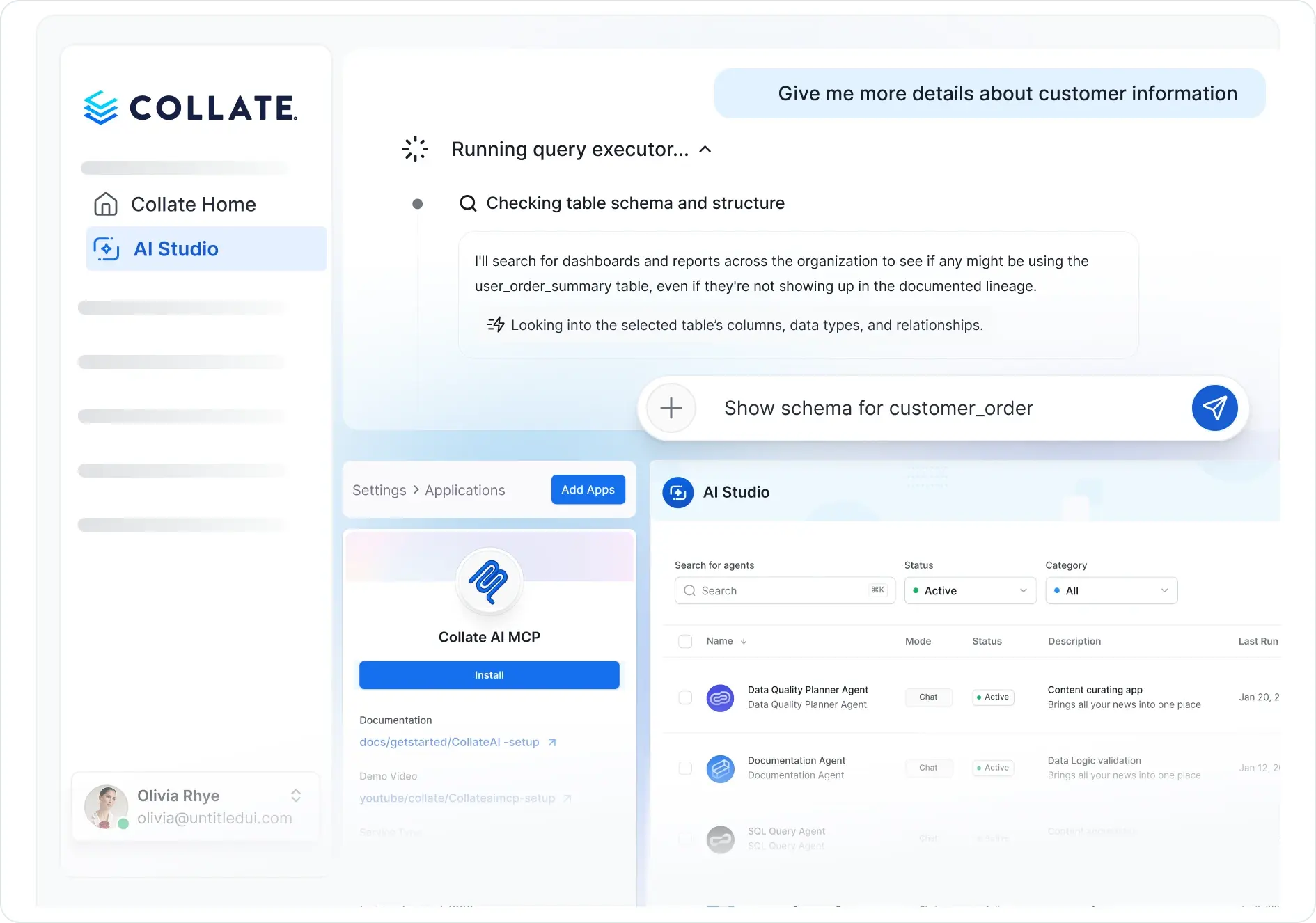
Collate is the AI for Data platform built on OpenMetadata. It extends the open metadata standard with managed deployment, enterprise governance, conversational AI, code & no code agents, and an AI native experience.
Key features include:
- Built on OpenMetadata: Collate inherits the open standard, native connectors, and ontology of OpenMetadata while adding features for enterprise product deployments at scale.
- Collate AI conversational interface: Users ask natural-language questions in web, Slack, or Teams and get governed, sourced answers grounded in their own data.
- AI agents ecosystem: Pre-built agents and a no-code AI Studio automate documentation, tiering, classification, and data quality at scale, with an AI SDK for custom AI applications.
- Memory, skills, and automations: Every approval, tag, and steward decision is captured as a permanent, attributable record that feeds back into governance reporting and agent learning.
- Data marketplace and data products: Collate exposes trusted data products through a marketplace UI so business users self-serve, with integrated data access request workflows.
Source: Collate
3. DataHub

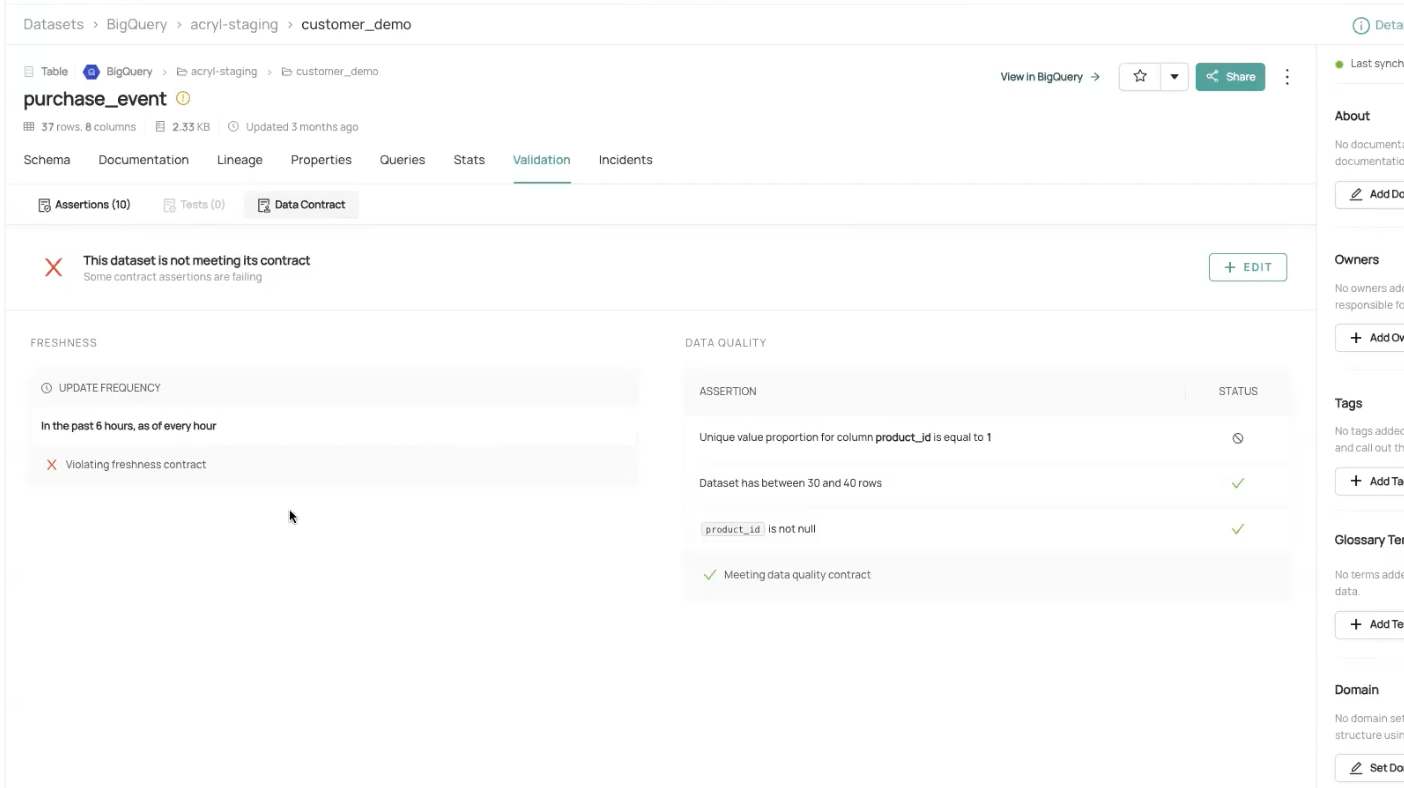
DataHub is an open-source metadata platform that acts as a central system for managing and understanding data across complex environments. It connects to multiple data systems and continuously collects metadata to build a unified view of data assets and their relationships.
Key features include:
- Unified metadata graph: DataHub builds a centralized graph representing datasets, pipelines, dashboards, and their relationships.
- Real-time metadata streaming: Metadata is updated continuously using a streaming-first architecture.
- Universal search across data assets: Provides a single search interface to find datasets, metrics, dashboards, and more.
- Column-level lineage tracking: Captures lineage at a fine-grained level, showing how individual fields move across systems.
- Flexible metadata ingestion framework: Supports push and pull ingestion models with over 80 connectors.
Source: Datahub
4. Apache Atlas
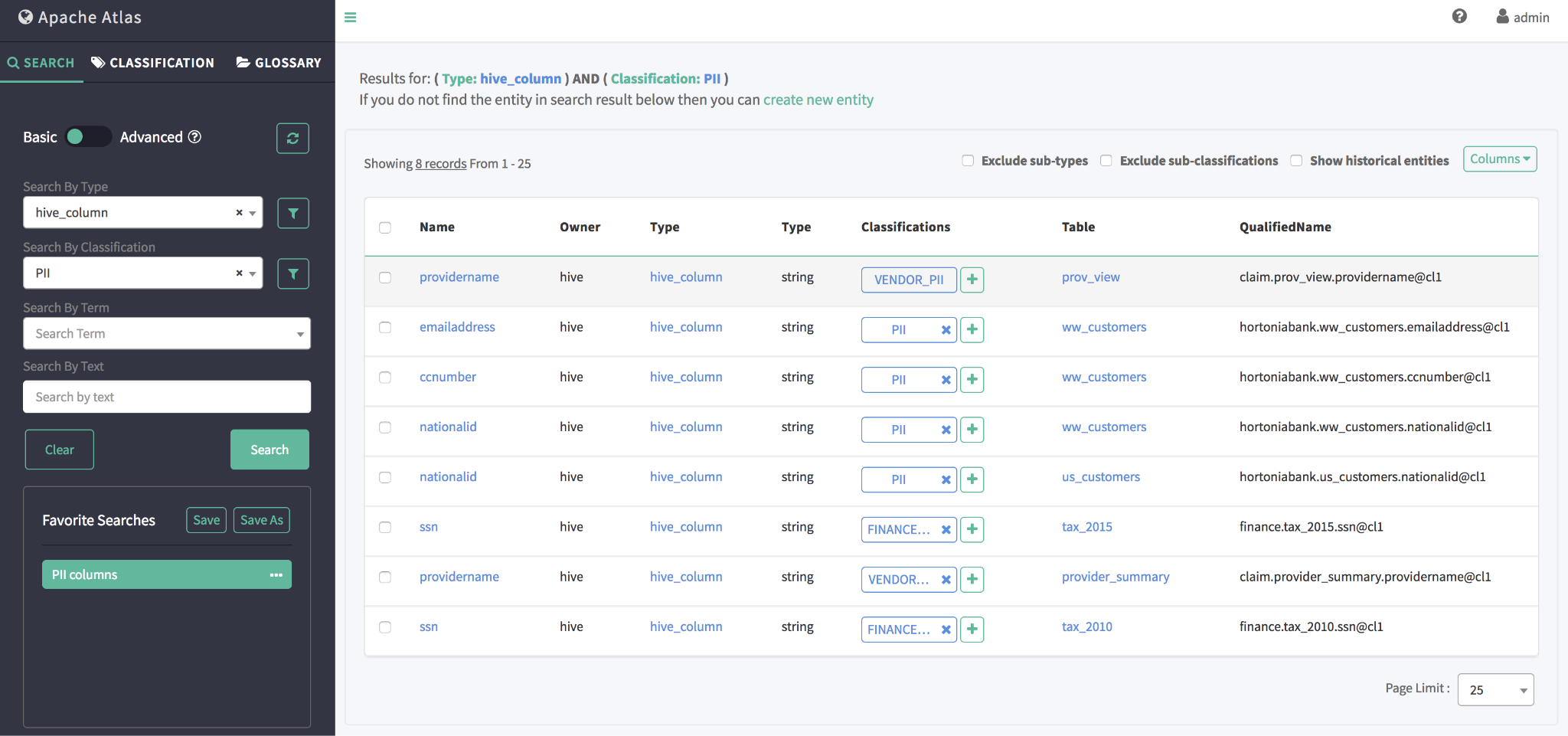
Apache Atlas is an open metadata and governance platform for managing, classifying, and controlling data across Hadoop and enterprise ecosystems. It provides a framework for defining metadata models, tracking data movement, and enforcing governance policies.
Key features include:
- Extensible metadata modeling: Supports predefined and custom metadata types with inheritance and relationships.
- Entity-based metadata management: Represents metadata objects as entities with defined types and relationships.
- REST APIs for integration: Exposes APIs for managing metadata types and entities.
- Dynamic data classification: Supports classifications such as PII or sensitive data with custom attributes.
- Classification propagation through lineage: Propagates classifications automatically along data lineage.
Source: Apache Atlas
Cloud Instance Metadata
5. AWS EC2 Instance Metadata Service
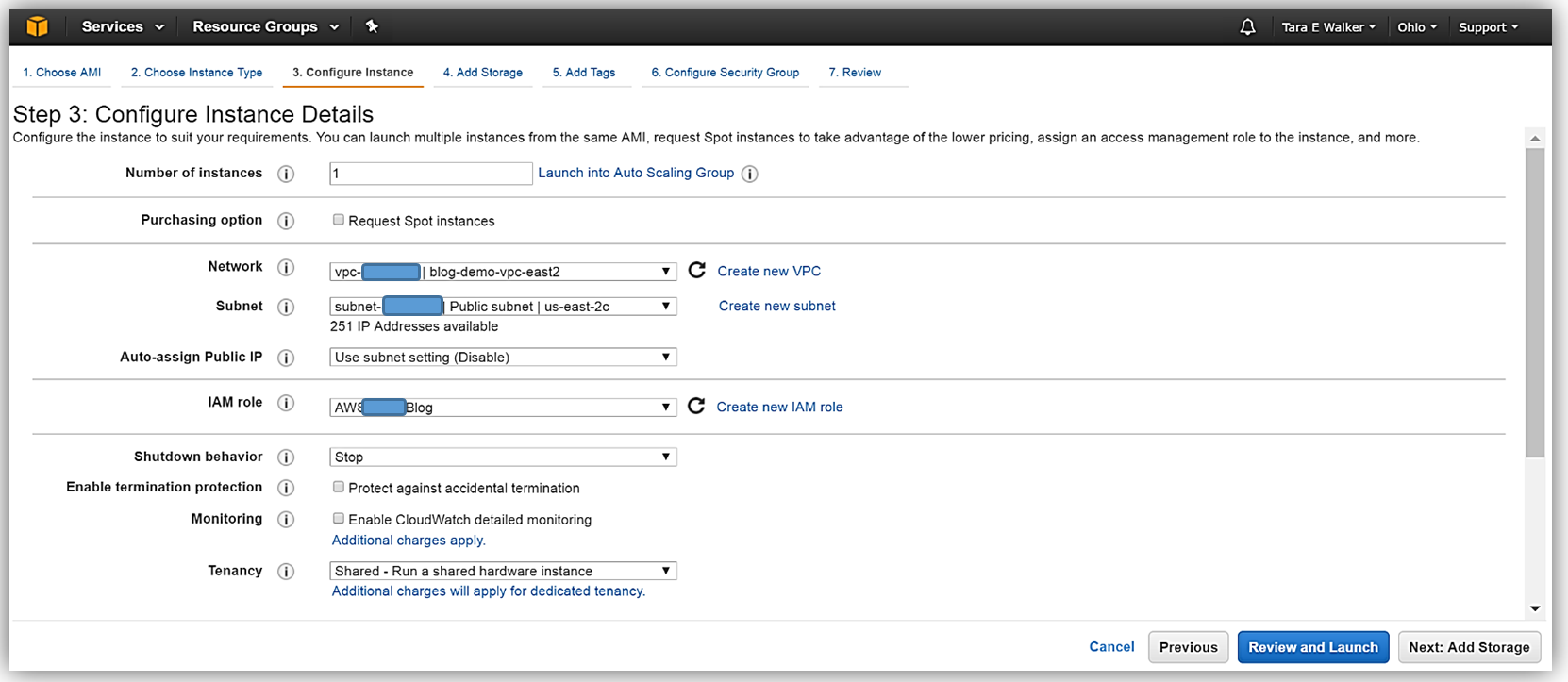
The AWS EC2 Instance Metadata Service (IMDS) provides access to runtime metadata about an EC2 instance from within the instance. This includes instance identity, network configuration, and security credentials. It supports IMDSv1 and IMDSv2, with IMDSv2 using session-based access.
Key features include:
- Support for two access versions (IMDSv1 and IMDSv2): Can be configured to require IMDSv2 only.
- Session-oriented authentication (IMDSv2): Requires a session token created with a PUT request.
- Configurable session lifetime (token TTL): Tokens have a configurable time-to-live from one second up to six hours.
- Instance-specific token security: Tokens are bound to a specific EC2 instance.
- Standard HTTP access methods: Supports GET, HEAD, and PUT requests.
Source: Amazon Web Services
6. Azure Instance Metadata Service

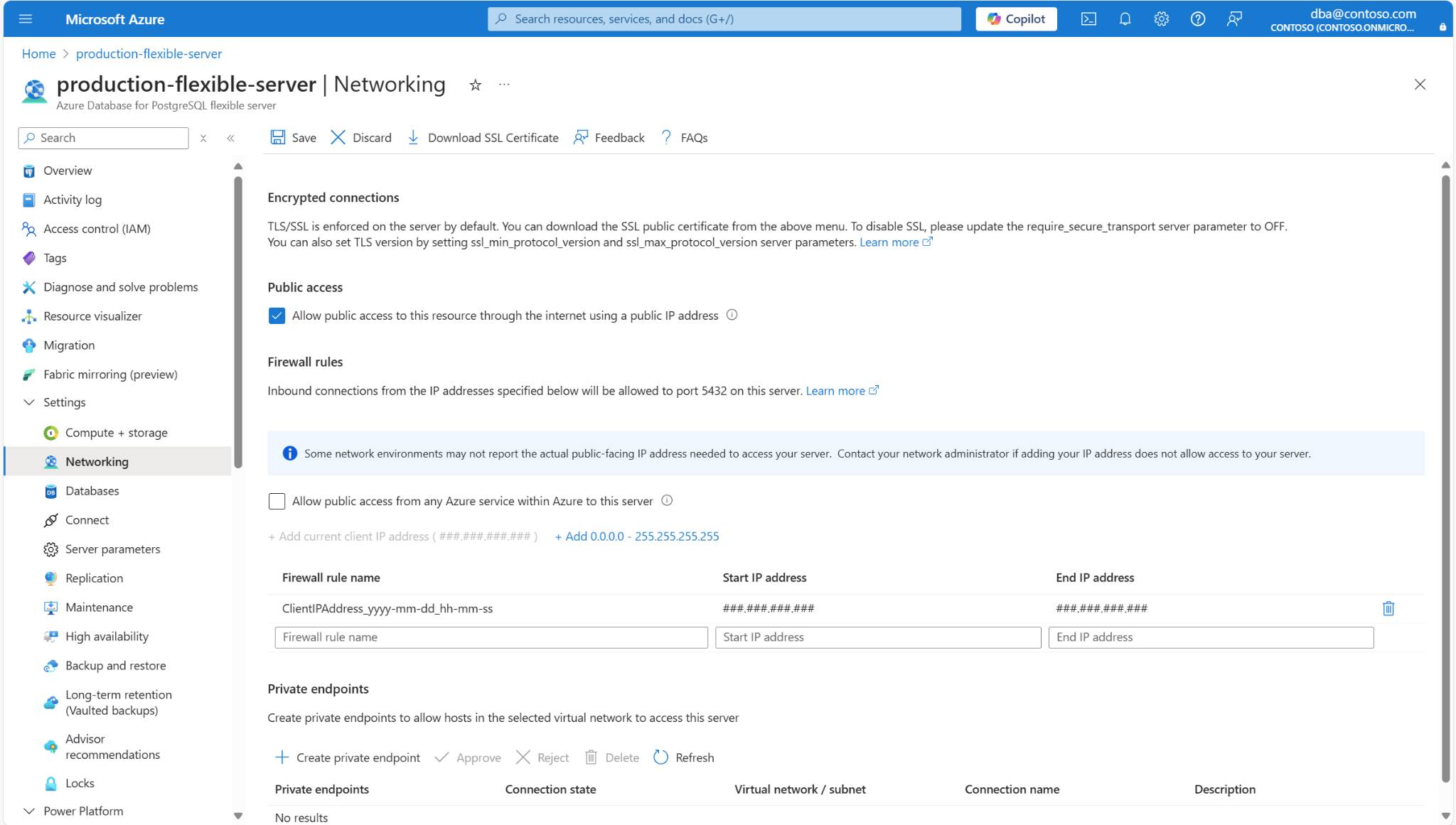
Azure Instance Metadata Service (IMDS) is a REST API that provides metadata about a running Azure virtual machine or scale set instance. It exposes compute, storage, network, identity, load balancer, and maintenance information from inside the VM.
Key features include:
- Local metadata access: Available at 169.254.169.254 and accessible only from inside the VM.
- REST-based interface: Exposes metadata through HTTP GET requests.
- Required metadata header: Requires the Metadata: true header and rejects requests with X-Forwarded-For.
- Compute metadata: Provides VM details such as name, region, VM size, OS type, image details, tags, and security profile.
- Storage metadata: Returns OS disk and data disk information, including size, caching mode, and disk IDs.
Source: Azure
7. Google Cloud VM Metadata

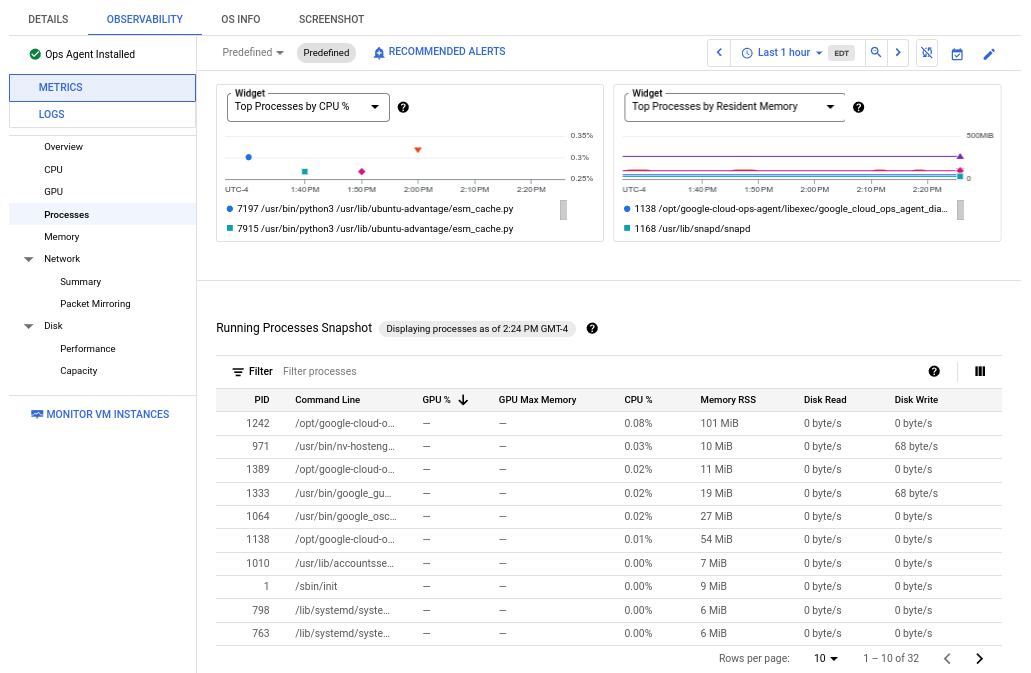
Google Cloud VM Metadata provides runtime information for Compute Engine VM instances through a local metadata server. Each VM can access this metadata without extra authorization. Metadata is stored as case-sensitive key-value pairs and organized into directories for project, zonal, and instance-level data.
Key features include:
- Local metadata server access: Each VM can query its metadata from a local metadata server. Requests and responses stay on the physical host running the VM, so they do not travel outside the host.
- Http and https endpoints: Metadata is available through HTTP endpoints on all VM types. HTTPS endpoints are also available for Shielded VMs, adding protection against spoofing, impersonation, and metadata tampering.
- Predefined metadata keys: Compute Engine automatically provides predefined metadata keys, such as VM instance ID, project ID, hostname, and scheduling details. These keys are consistent across VMs, making scripts easier to reuse.
- Custom metadata keys: Users can define their own key-value pairs at the VM or project level. Custom metadata is useful for passing configuration values, environment settings, or script parameters to VMs.
- Startup and shutdown script support: Metadata can be used by startup and shutdown scripts to configure VMs automatically. For example, a script can retrieve the VM’s external IP address or custom configuration values during boot.
Conclusion
Metadata services are fundamental for managing the modern, distributed data estate. They establish trust, enable robust governance, and drive self-service analytics by centralizing context. By unifying schemas, lineage, and policies, these services ensure data is discoverable, compliant, and ready for advanced applications like AI agents and machine learning workflows.